
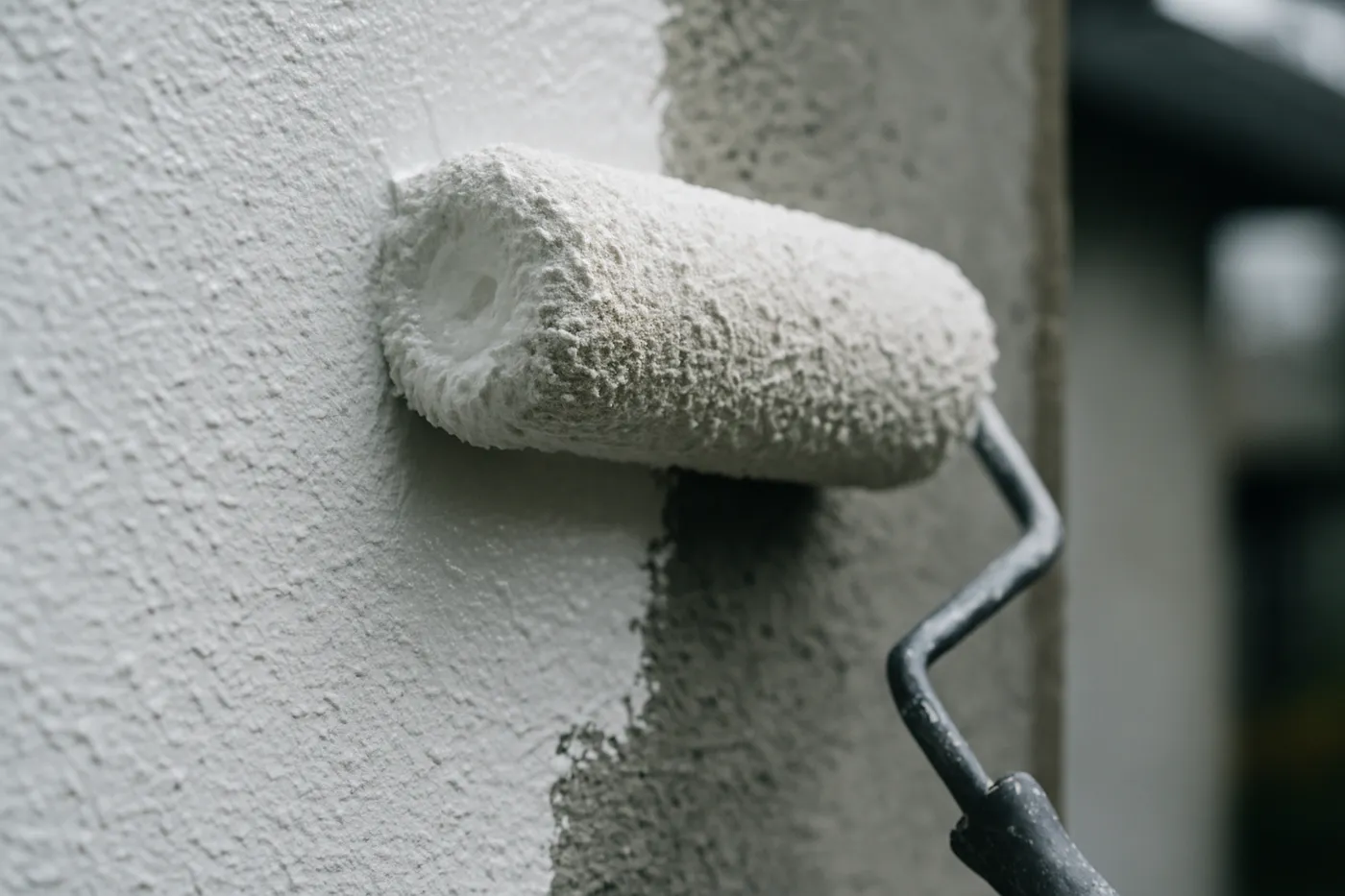
Standard exterior paint is thin and relatively rigid. Elastomeric coating is neither. It goes on many times thicker, it stays flexible after it cures, and it is built to move with the building instead of cracking when the building moves. On the right surface, in the right climate, that difference is the line between a wall that sheds water for years and one that lets water in behind it.
How it waterproofs
Three properties do the work, and they only matter together.
Crack-bridging. Stucco and masonry develop hairline cracks as they age and as temperatures swing. A standard coat of paint sits on top and cracks along with them. An elastomeric coating is elastic enough to stretch across those hairline gaps and stay intact, so water has no open seam to follow inside.
Membrane build. Because it is applied at a high mil thickness, an elastomeric coating builds an actual membrane over the surface rather than a thin film. That continuous, thick layer is what blocks wind-driven rain from soaking into porous masonry.
Breathability. The catch with sealing a wall is that any moisture already inside needs a way out, or it gets trapped and causes its own damage. Quality elastomeric systems are formulated to let water vapor escape while still blocking liquid water from getting in. You get the seal without sealing moisture inside the assembly.
On masonry and stucco, that combination beats standard exterior paint decisively. Standard paint can look fine for a season and then begin failing at every hairline crack, while a properly built elastomeric membrane keeps moving with the wall.
Where it works (and where it doesn’t)
Elastomeric coatings are made for masonry-family surfaces:
- Stucco, where hairline cracking is routine and crack-bridging matters most.
- Concrete masonry units (CMU) and block, where the porous surface needs a real membrane.
- Poured and precast concrete, for sealing and waterproofing exposed faces.
- EIFS (exterior insulation and finish systems), where the right elastomeric system is part of the assembly.
Where they are not the answer: a coating cannot fix a failing substrate. If the wall is spalling, delaminating, or actively leaking from a flashing or detailing failure, coating over it just hides the problem. Those issues get repaired first. Elastomeric is also not the default for wood siding, which moves and breathes differently and is usually better served by a quality exterior paint system. The wrong surface is the most common way this product disappoints.
Elastomeric vs standard exterior paint
| Factor | Standard exterior paint | Elastomeric coating |
|---|---|---|
| Film thickness | Thin film | High mil build, true membrane |
| Flexibility | Relatively rigid | Stays flexible, stretches with the surface |
| Crack-bridging | Limited; cracks with the surface | Bridges hairline cracks |
| Best surfaces | Wood, prepped siding, trim | Stucco, masonry, concrete, EIFS |
| Breathability | Varies | Engineered to release vapor, block liquid water |
| Typical lifespan | Shorter on masonry | Longer on masonry when properly applied |
Own a stucco or masonry building? We repair cracks and prep the substrate before we coat, then build to the correct mil thickness. Get a free written estimate.
What it costs
Elastomeric work is priced by square footage, the condition of the surface, the mil thickness the system calls for, and how much prep and crack repair the wall needs before coating. A sound stucco wall that needs cleaning and a single recoat is a different job from a cracked, weathered facade that needs repair, primer, and a full membrane build.
We do not quote elastomeric work over the phone, because the prep is where the real cost lives and we cannot see it from a desk. We walk the building, assess the substrate, and give you a free written estimate that reflects the actual condition and the system the surface requires.
Elastomeric coatings in the Pacific Northwest
The Pacific Northwest is a hard test for any exterior, and it is close to a worst case for masonry. Heavy, wind-driven rain pushes water at vertical surfaces for months. Then seasonal freeze-thaw cycles take over: water gets into a hairline crack, freezes, expands, and widens the crack, which lets in more water next time. Standard paint on stucco or masonry cannot keep up with that cycle for long.
A flexible, waterproof elastomeric membrane is built for exactly this stress, which is why it shows up so often on commercial and multifamily buildings across Bellevue, Seattle, and Bellingham. For a building owner here, the question is rarely whether the wall will be tested. It is whether the coating was built to pass.
How Hedlund does it
We have spent over a decade as a licensed, bonded, and insured contractor, and a large share of that work has been on commercial, HOA, and multifamily building envelopes. That experience shows up in the order of operations: we repair cracks and prep the substrate first, then build to the correct mil thickness, using manufacturer systems such as Dryvit and Tnemec specified to the surface.
The frustration elastomeric coating is supposed to solve is a low bidder who skips the prep, sprays a coat on a cracked wall, and lets water back in behind it within a year. The membrane is only as good as the surface under it, and the prep is the part that does not show up in a cheap bid.
“Our condo community had the joy of working with Rigo to coordinate getting our buildings painted. The process from beginning to end was smooth.” Holly H., 5 stars (Google)
For the full specialty range, see our Specialty & Protective Coatings page and the masonry and stucco sealing detail. We also handle commercial painting and HOA and multifamily painting. Related reading: Faux Finishes: What’s Possible and Where They Work and Fire and Intumescent Coatings: A Building Owner’s Primer.